
Support healthy nitric oxide naturally.
Nitric Oxide Saliva Strips
Saliva Strips for Nitric Oxide
Maintaining nitric oxide for optimal immune, heart, and brain wellness requires both dietary prebiotic nitrate from plant-based foods as well as friendly nitrate-reducing bacteria on your tongue.

THE SCIENCE
Nitric oxide is as important as the oxygen you breath.
It is a vital molecule produced in your body that protects against infection, promotes blood flow to the brain, lessens the stress to your heart, and improves exercise performance as you age.
MyFitStrip are patent-pending saliva strips to help detect for the presence of the oral microflora or nitric oxide probiotics that are necessary to convert dietary nitrate to nitric oxide.
your nitric oxide
Know your nitric oxide. Nitric oxide is vital to life.
As we grow older, we lose the ability to make nitric oxide.
As a result, plant-based diets become our primary source of nitric oxide.
To replenish, we need nitrate-rich plant-based natural foods and friendly probiotics or an established nitrate-reducing microbiome that help us make nitric oxide.
You can now check for both dietary prebiotic nitrates and the corresponding nitrate-reducing oral microbiome with MyFitStrip, the next generation saliva nitric oxide saliva strip.
Microbiome Saliva Strips
MyFitStrip Nitric Oxide Microbiome Saliva Strips
Start your day by checking for your nitric oxide with MyFitStrip.
If deficient, eat prebiotic nitrate-rich natural, plant-based foods, and check again 2 hours later.

Checking is easy and results are instant
Wellness is Personal
Within 10-seconds of checking, MyFitStrip will detect whether dietary prebiotic nitrate from your plant-based foods are being absorbed in your gut and whether the microflora on your tongue have begun the process of transforming nitrate into beneficial nitric oxide.

nitric oxide conversion
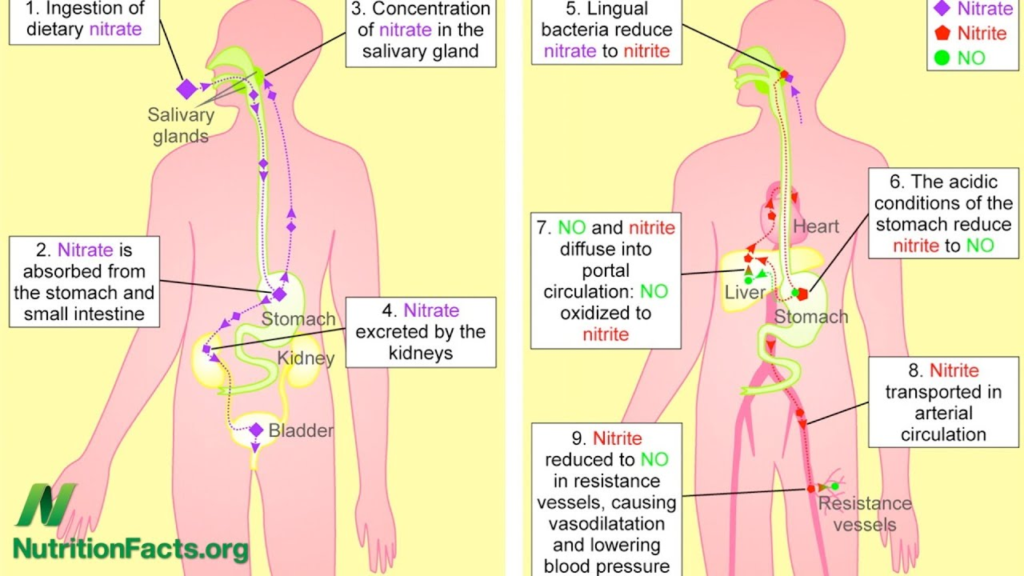
Friendly bacteria living on your tongue is necessary to transform or reduce nitrate to nitrite, a necessary and required step for nitric oxide conversion
MyFitStrip checks whether the nitric oxide promoting bacteria are active. The natural nitrate-reducing microbiome on our tongue are essential for converting dietary nitrates in vegetables such as beetroot, spinach, arugula and other nitrate-rich whole plant-based foods.
Questions
Frequently Asked Questions
Still have questions? Our science team is ready to help.
Nitric oxide (NO) is a short-lived gas made by nearly every cell in the body. It effects are widespread and diverse. NO is an important signaling molecule in our brain and a molecule that dilates our blood vessels. It keeps our blood cells from sticking together, thereby helping the flow of blood throughout our body.
NO helps oxygen get to the brain and oxygen-deprived muscles more efficiently during exercise. Insufficient NO is often associated with chronic problems and age related diseases.
As we grow older, our cells lose the ability to make adequate amounts of NO. Therefore, dietary inorganic prebiotic nitrates, found in many vegetables, become a critical source. Prebiotic nitrates are absorbed in the gut and circulate to the saliva glands where they are released into the mouth. Upon release, nitrate is converted to nitrite by the friendly nitrate-reducing bacteria living on the back of the tongue. The nitrite is subsequently swallowed and further reduced in the gut and circulation to nitric oxide to exert its health benefits.
Beets and leafy greens, including spinach, arugula, rhubarb, chard, kale, are rich in inorganic prebiotic nitrate. The consumption of leafy greens and other potassium nitrate–rich vegetables, are the primary source of inorganic prebiotic nitrate found in the Mediterranean, DASH and MIND diet, and the traditional Japanese diet. All of these diets have been shown to exhibit nitric oxide-mediated effects in various clinical studies demonstrating improvement of vascular wellness.
Similar to our gut, our mouths contain a mix of good and bad bacteria. Having a 'good microflora' on our tongue that converts dietary prebiotic nitrate to nitrite is critical in restoring vascular health. Eradication of oral nitrate-reducing bacteria through antiseptic mouthwash, such as chlorhexidine, or overuse of antibiotics can result in cardiometabolic challenges.
Studies have also found that periodic tongue brushing may provoke the growth of these healthy nitrate-reducing bacteria. Others have found that increased dietary intake of inorganic nitrate shifted the oral microflora to a richer population of nitrate-reducing bacteria with improvements in cardiovascular wellness.
Learn more
Relevant Clinical Studies
1
Webb AJ, Patel N, Loukogeorgakis S, Okorie M, Aboud Z, Misra S, Rashid R, Miall P, Deanfield J, Benjamin N, MacAllister R, Hobbs AJ, Ahluwalia A.
Acute BP Lowering, Vasoprotective, and Antiplatelet Properties of Dietary Nitrate via Bioconversion to Nitrite.
Hyperten. 2008 Mar;51(3):784-90. Epub 2008 Feb 4.
2
Wink DA, Paolocci N.
Mother Was Right: Eat Your Vegetables and Do Not Spit! When Oral Nitrate Helps With High BP.
Hyperten. 2008 Mar;51(3):617-9. Epub 2008 Feb 4.
3
Vanhatalo A, Blackwell JR, L'Heureux JE, Williams DW, Smith A, van der Giezen M, Winyard PG, Kelly J, Jones AM.
Nitrate-responsive oral microbiome modulates nitric oxide homeostasis and BP in humans.
Free Radic Biol Med. 2018 Aug 20;124:21-30.
4
Tribble GD, Angelov N, Weltman R, Wang BY, Eswaran SV, Gay IC, Parthasarathy K, Dao DV, Richardson KN, Ismail NM, Sharina IG, Hyde ER, Ajami NJ, Petrosino JF, Bryan NS.
Frequency of Tongue Cleaning Impacts the Human Tongue Microbiome Composition and Enterosalivary Circulation of Nitrate.
Front Cell Infect Microbiol. 2019 Mar 1;9:39.
5
Liddle L, Burleigh MC, Monaghan C, Muggeridge DJ, Sculthorpe N, Pedlar CR, Butcher J, Henriquez FL, Easton C.
Variability in nitrate-reducing oral bacteria and nitric oxide metabolites in biological fluids following dietary nitrate administration: An assessment of the critical difference.
Nitric Oxide. 2019 Feb 1;83:1-10.
6
Burleigh MC, Liddle L, Monaghan C, Muggeridge DJ, Sculthorpe N, Butcher JP, Henriquez FL, Allen JD, Easton C.
Saliva nitrite production is elevated in individuals with a higher abundance of oral nitrate-reducing bacteria.
Free Radic Biol Med. 2018 May 20;120:80-88.
7
Woessner M, Smoliga JM, Tarzia B, Stabler T, Van Bruggen M, Allen JD.
Stepwise reduction in plasma and salivary nitrite with increasing strengths of mouthwash following a dietary nitrate load.
Nitric Oxide. 2016 Apr 1;54:1-7.
8
Ormesher L, Myers JE, Chmiel C, Wareing M, Greenwood SL, Tropea T, Lundberg JO, Weitzberg E, Nihlen C, Sibley CP, Johnstone ED, Cottrell EC.
Effects of dietary nitrate supplementation, from beetroot juice, on BP in hypertensive pregnant women: A randomised, double-blind, placebo-controlled feasibility trial.
Nitric Oxide. 2018 Nov 1;80:37-44.
9
Govoni M, Jansson EA, Weitzberg E, Lundberg JO.
The increase in plasma nitrite after a dietary nitrate load is markedly attenuated by an antibacterial mouthwash.
Nitric Oxide. 2008 Dec;19(4):333-7.
10
Jonvik KL, Nyakayiru J, Pinckaers PJ, Senden JM, van Loon LJ, Verdijk LB.
Nitrate-Rich Vegetables Increase Plasma Nitrate and Nitrite Concentrations and Lower BP in Healthy Adults.
J Nutr. 2016 May;146(5):986-93.
11
McDonagh STJ, Wylie LJ, Webster JMA, Vanhatalo A, Jones AM.
Influence of dietary nitrate food forms on nitrate metabolism and BP in healthy normotensive adults.
Nitric Oxide. 2018 Jan 30;72:66-74.
12
Hohensinn B, Haselgrübler R, Müller U, Stadlbauer V, Lanzerstorfer P, Lirk G, Höglinger O, Weghuber J.
Sustaining elevated levels of nitrite in the oral cavity through consumption of nitrate-rich beetroot juice in young healthy adults reduces salivary pH.
Nitric Oxide. 2016 Nov 30;60:10-15.
13
Govoni M, Jansson EA, Weitzberg E, Lundberg JO.
The increase in plasma nitrite after a dietary nitrate load is markedly attenuated by an antibacterial mouthwash.
Nitric Oxide. 2008 Dec;19(4):333-7. Epub 2008 Aug 30.
14
LJ Wylie, J Kelly, SJ Bailey, JR Blackwell, PF Skiba, PG Winyard, AE Jeukendrup, A Vanhatalo, AM Jones.
Beetroot juice and exercise: pharmacodynamic and dose-response relationships.
J Appl Physiol (1985). 2013 Aug 1;115(3):325-36.
15
NF Hord, Y Tang, NS Bryan.
Food sources of nitrates and nitrites: the physiologic context for potential health benefits.
Am J Clin Nutr. 2009 Jul;90(1):1-10.
16
S Lidder, AJ Webb.
Vascular effects of dietary nitrate (as found in green leafy vegetables and beetroot) via the nitrate-nitrite-nitric oxide pathway.
Br J Clin Pharmacol. 2013 Mar;75(3):677-96.
17
T D Presley, A R Morgan, E Bechtold, W Clodfelter, R W Dove, J M Jennings, R A Kraft, S B King, P J Laurienti, W J R ejeski, J H Burdette, D B Kim-Shapiro, G D Miller.
Acute effect of a high nitrate diet on brain perfusion in older adults.
Nitric Oxide. 2011 Jan 1;24(1):34-42.
18
A A Kenjale, K L Ham, T Stabler, J L Robbins, J L Johnson, M Vanbruggen, G Privette, E Yim, W E Kraus, J D Allen.
Dietary nitrate supplementation enhances exercise performance in peripheral arterial disease.
J Appl Physiol (1985). 2011 Jun;110(6):1582-91.
19
M Murphy, K Eliot, R M Heuertz, E Weiss.
Whole beetroot consumption acutely improves running performance.
J Acad Nutr Diet. 2012 Apr;112(4):548-52.
20
M J Berry, N W Justus, J I Hauser, A H Case, C C Helms, S Basu, Z Rogers, M T Lewis, G D Miller.
Dietary nitrate supplementation improves exercise performance and decreases BP in COPD patients.
Nitric Oxide. 2015 Aug 1;48:22-30.
21
A Jajja, A Sutyarjoko, J Lara, K Rennie, K Brandt, O Qadir, M Siervo.
Beetroot supplementation lowers daily systolic BP in older, overweight subjects.
Nutr Res. 2014 Oct;34(10):868-75.
22
V Kapil, R S Khambata, A Robertson, M J Caulfield, A Ahluwalia.
Dietary nitrate provides sustained BP lowering in hypertensivepatients: a randomized, phase 2, double-blind, placebo-controlled study.
Hyperten. 2015 Feb;65(2):320-7.
23
E Weitzberg, J O Lundberg.
Novel aspects of dietary nitrate and human health.
Annu Rev Nutr. 2013;33:129-59.
24
M P Hezel, E Weitzberg.
The oral microbiome and nitric oxide homoeostasis.
Oral Dis. 2015 Jan;21(1):7-16.
25
N S Bryan.
Pharmacological therapies, lifestyle choices and nitric oxide deficiency: a perfect storm.
Pharmacol Res. 2012 Dec;66(6):448-56.
26
C P Bondonno, K D Croft, I B Puddey, M J Considine, X Yang, N C Ward, J M Hodgson.
Nitrate causes a dose-dependent augmentation of nitric oxide status in healthy women.
Food Funct. 2012 May;3(5):522-7.
27
W T Clements, S R Lee, R J Bloomer.
Nitrate ingestion: a review of the health and physical performance effects.
Nutrients. 2014 Nov 18;6(11):5224-64.
28
F J Larsen, T A Schiffer, S Borniquel, K Sahlin, B Ekblom, J O Lundberg, E Weitzberg.
Dietary inorganic nitrate improves mitochondrial efficiency in humans.
Cell Metab. 2011 Feb 2;13(2):149-59.
29
M Murphy, K Eliot, R M Heuertz, E Weiss.
Whole beetroot consumption acutely improves running performance.
J Acad Nutr Diet. 2012 Apr;112(4):548-52.
30
D A Hobbs, M G Goulding, A Nguyen, T Malaver, C F Walker, T W George, L Methven, J A Lovegrove.
Acute ingestion of beetroot bread increases endothelium-independent vasodilation and lowers diastolic BP in healthy men: a randomized controlled trial.
J Nutr. 2013 Sep;143(9):1399-405.
31
D A Hobbs, N Kaffa, T W George, L Methven, J A Lovegrove.
BP-lowering effects of beetroot juice and novel beetroot-enriched bread products in normotensive male subjects.
Br J Nutr. 2012 Dec 14;108(11):2066-74.
32
V Bond Jr, B H Curry, R G Adams, R M Millis, G E Haddad.
Cardiorespiratory function associated with dietary nitrate supplementation.
Appl Physiol Nutr Metab. 2014 Feb; 39(2): 168–172.
33
H K Engan, A M Jones, F Ehrenberg, E Schagatay.
Acute dietary nitrate supplementation improves dry static apnea performance.
Respir Physiol Neurobiol. 2012 Jul 1;182(2-3):53-9.